Begin with daily life
Food and clothing offer recognizable entry points into a less visible ecological relationship.
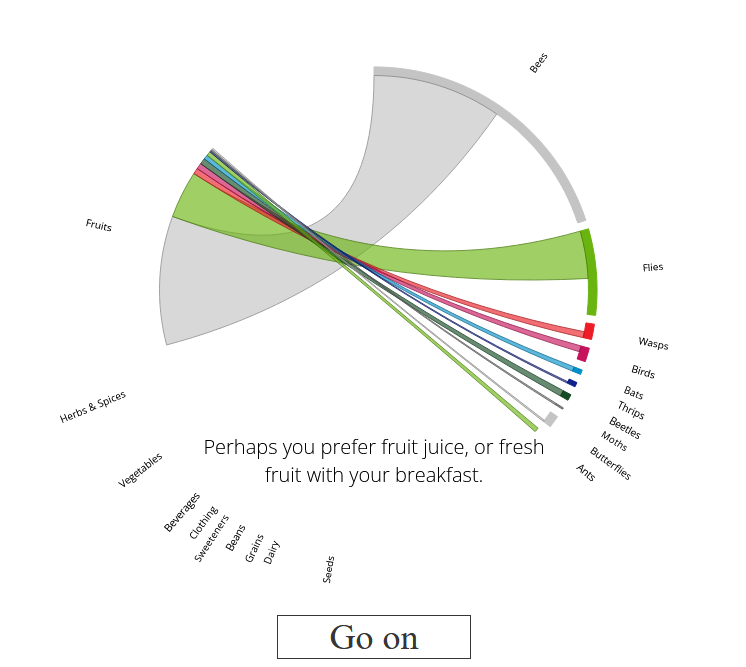
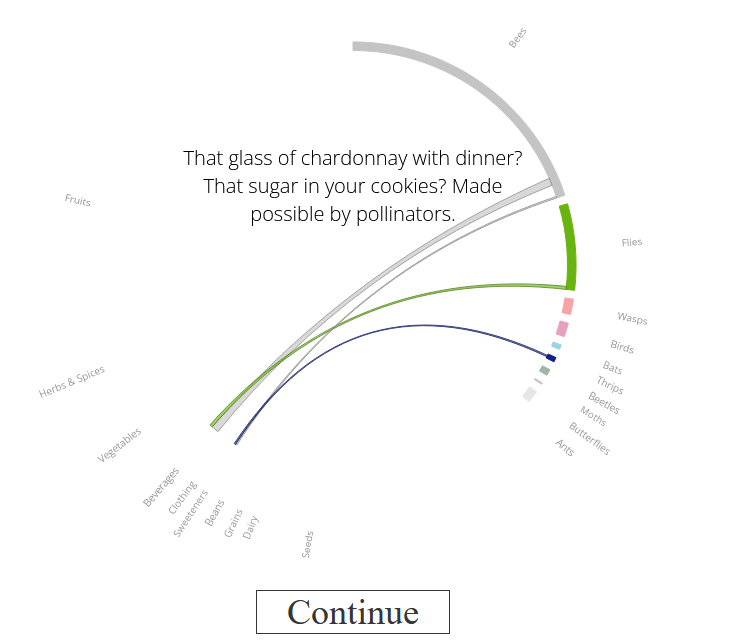
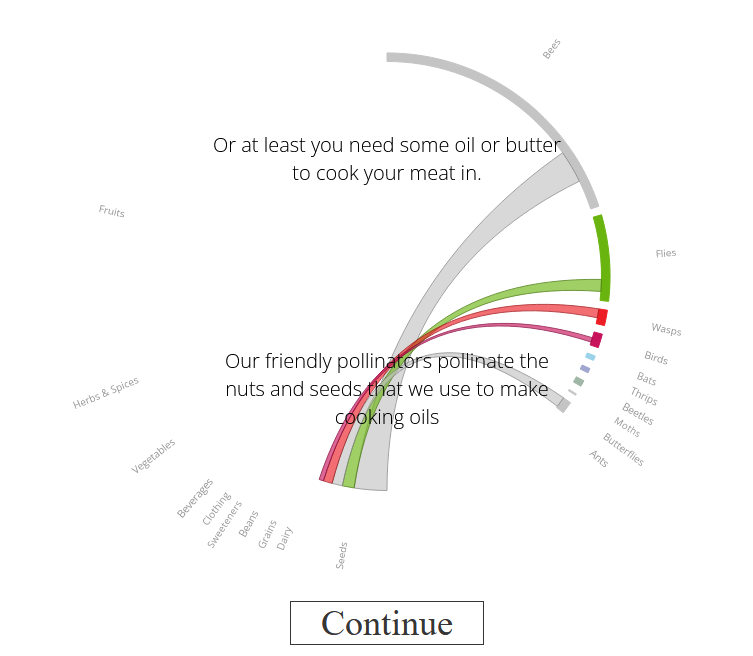
Interactive chord diagrams exploring relationships between pollinators and plants.

Selected project · Pollinator education
An interactive story connecting pollinators to everyday foods and materials—designed to encourage a local homeowners’ association to reconsider its restrictions on beekeeping.
The challenge
The project began with a local question: how could I make a persuasive case for allowing beekeeping in a neighborhood where it was restricted? I chose to connect pollinators to familiar foods and materials, giving the topic a place in everyday life.
Created at MICA with an HOA audience in mind, the project combined research, writing, design, and coding.
Try the interactive
Move through a short sequence of everyday examples, or explore the full diagram. Select a category in the menu or on the diagram to highlight its connections.
Restored from the original project files, with responsive layout and updated controls. The original relationship matrix is retained; its data source is unconfirmed.
The design approach
The chord diagram brings many relationships into one view. A guided sequence introduces selected connections before inviting readers to explore the larger network.
Food and clothing offer recognizable entry points into a less visible ecological relationship.
Highlighting selected categories keeps the full network from overwhelming the first encounter.
Open exploration lets readers follow a category that interests them after the guided story.
The outcome
The finished student project used visual storytelling to make the importance of pollinators more tangible and support a case for reconsidering local beekeeping restrictions. It demonstrates how I combine narrative, data visualization, and interaction around a specific communication goal.
MICA academic project · Courtney Reckord · Intended audience: local HOA leadership. Original code credits a chord-diagram example by Nadieh Bremer.